
Bringing a newborn baby home is exciting, emotional and, if you have a dog, a little nerve racking. You may know your dog well, but a baby changes the household in ways your dog cannot understand.
This guide explains how to prepare before the baby arrives, manage the first introduction safely, read early warning signs and build calm routines once family life changes.
The aim is a safe baby, a secure dog and a home that feels manageable for everyone.
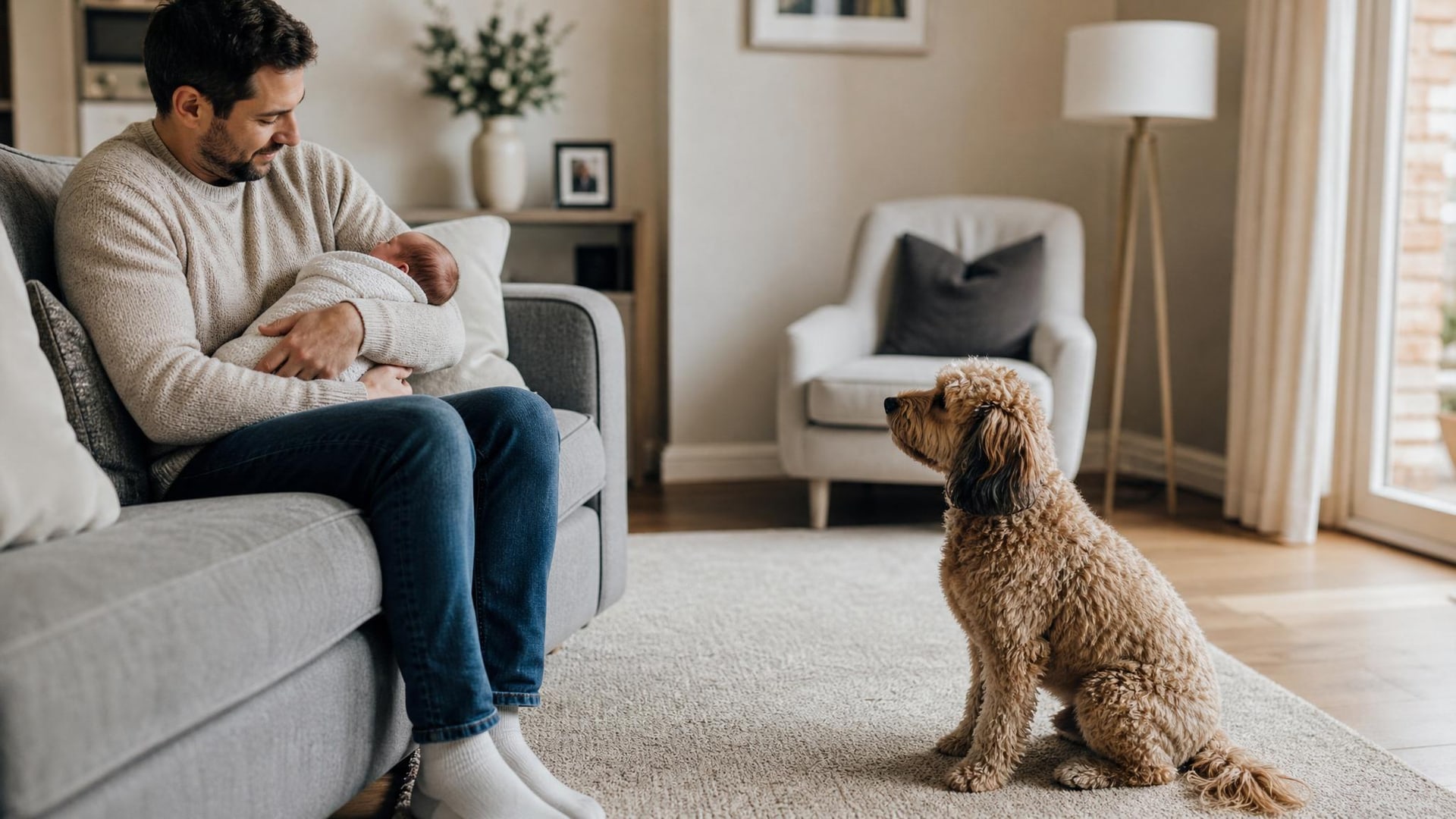
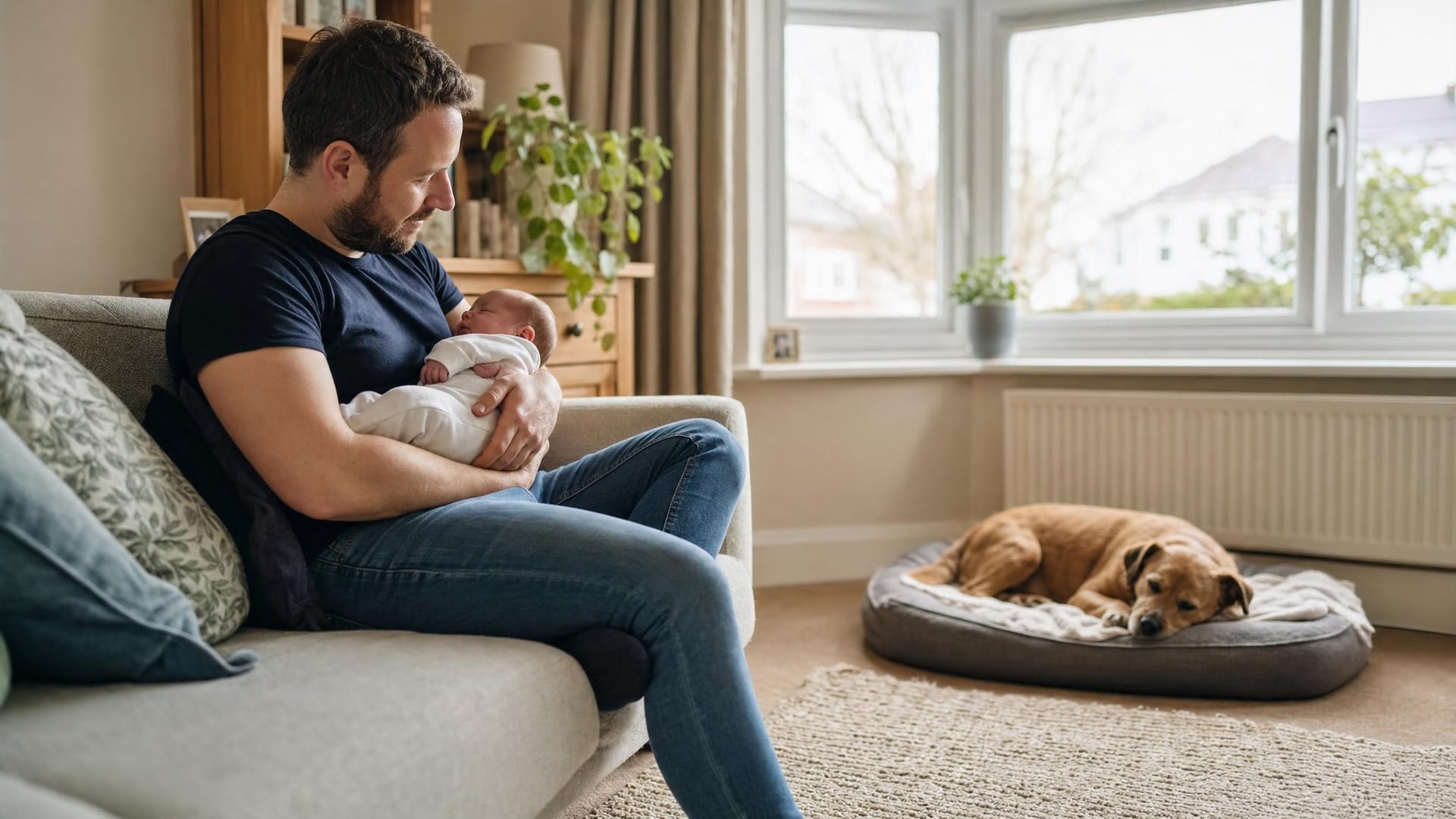
The safest way to introduce your dog to a newborn baby is to prepare before the baby arrives, keep the first meeting short and controlled, and reward calm behaviour around the baby.
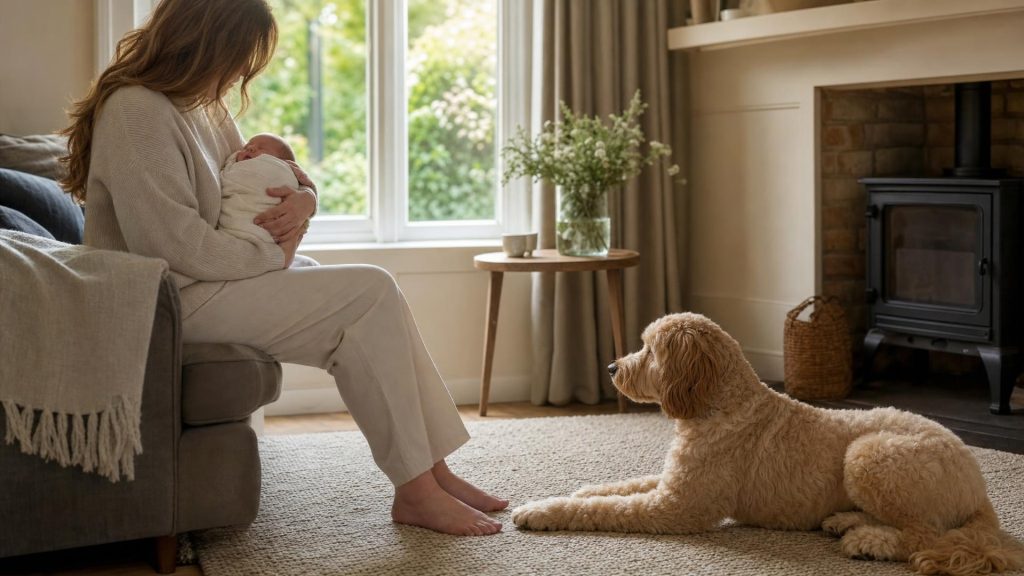
One adult should hold the baby while another adult manages the dog. Use a lead or baby gate if your dog may rush forward, jump or become overexcited. Let your dog observe from a distance first. A brief sniff near the baby’s feet may be allowed only if your dog is relaxed, but avoid face contact and licking.
Never force interaction, and never leave your dog and newborn alone together.
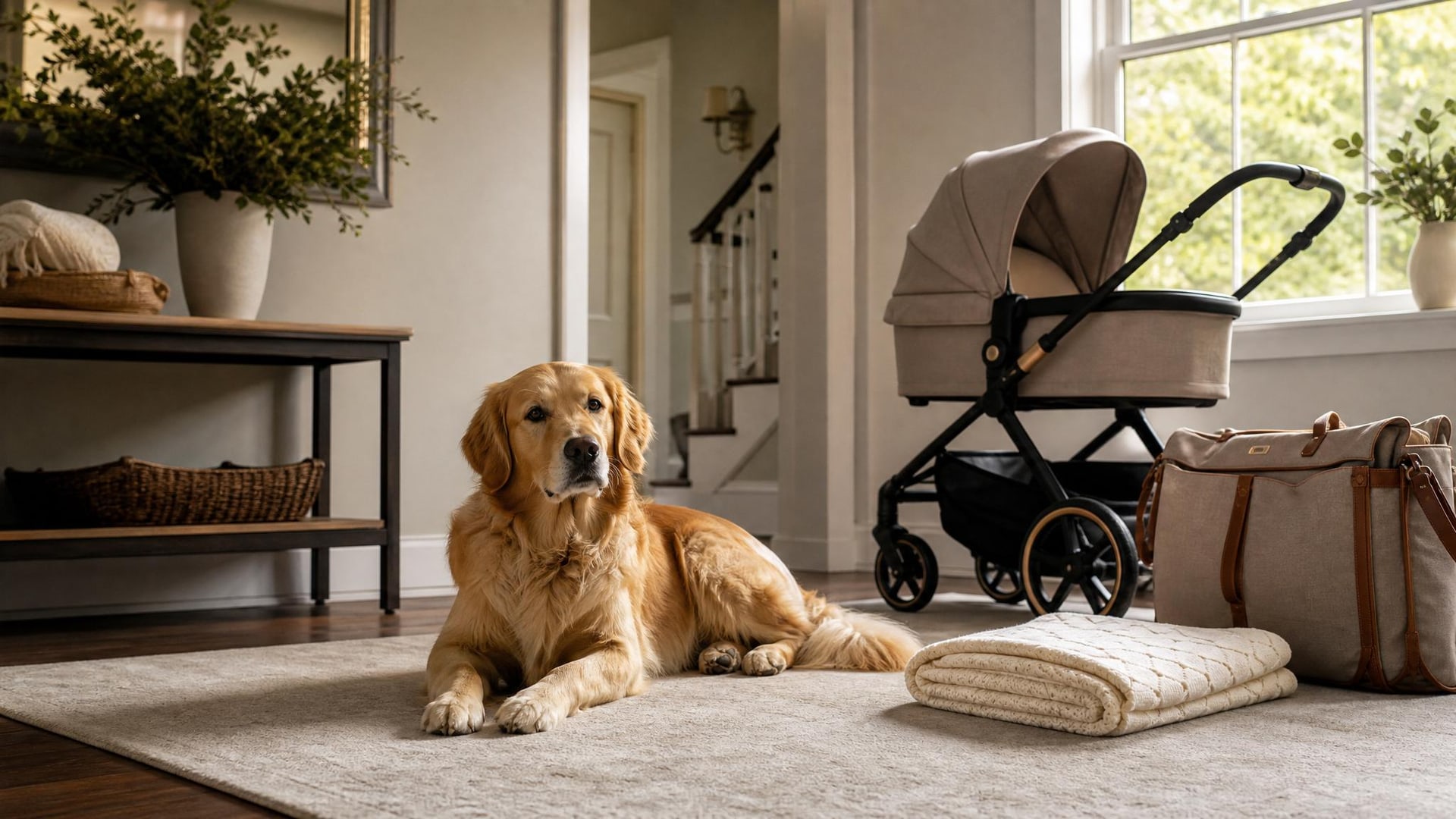
The best introductions usually begin weeks before the baby arrives. Your dog should not feel as though the baby came home and everything familiar disappeared overnight.
Dogs notice routine changes. They notice when rooms become unavailable, walks move to different times, visitors arrive more often, or they are suddenly asked to settle away from you.
If all of that happens at once, your dog may connect the baby with disruption. Preparing early helps your dog learn the new rhythm before tiredness and newborn demands make everything harder.
Think honestly about what is likely to change after the birth. If your dog currently sleeps in your bedroom but will later sleep elsewhere, start that transition before the baby arrives.
If your dog is used to a long walk at exactly the same time each morning, practice a little flexibility.
If the nursery will be out of bounds, teach that calmly before there is a baby in it.
Gradual changes are kinder because they do not make the baby seem like the cause of every new restriction. Keep the changes small, reward calm behaviour, and give your dog time to adjust before adding the next change.
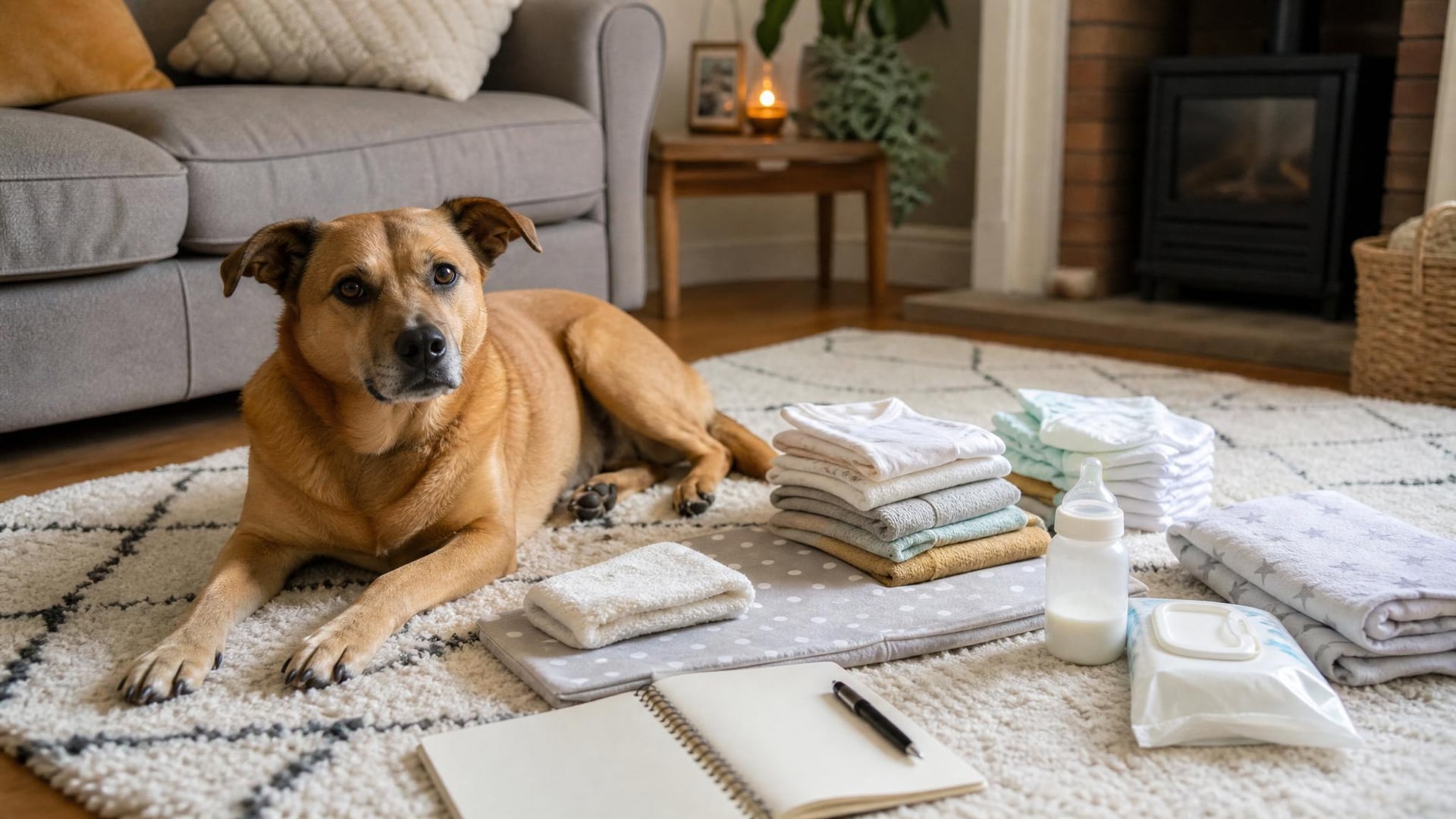
It can help to write down your dog’s current day and mark what may change; sleeping place, walk times, feeding, sofa access, door greetings, time alone and access to upstairs rooms. Anything that needs to change should change before the baby arrives, not during the most emotional first day home.
You do not need military level obedience, but a few everyday cues make life safer when your hands are full. Practice them in quiet moments first, then around mild distractions.
These cues are not about being strict for the sake of it. They give your dog clear, familiar guidance at a time when the home may feel busier and less predictable.
Boundaries are easiest to teach when nobody is stressed. If your dog will not be allowed in the nursery, start rewarding them for waiting outside the room.
If they will need to stay behind a baby gate at certain times, make that gate a normal part of the house before the baby arrives.
If your dog currently jumps up, rushes through doors, steals items, barks for attention or follows you into every room, those habits are worth improving before the baby comes home.
You are not aiming for perfection. You are reducing the behaviours that could make newborn life less safe.
| Preparation task | Why it matters | How to practice it |
|---|---|---|
| Adjust walk and feeding routines | Prevents the baby being linked with sudden disruption | Vary timings slightly and reward calm settling between routines |
| Set up a quiet dog area | Gives your dog somewhere safe to retreat | Use a bed, crate if already positive, or gated area with water nearby |
| Practice calm greetings | Reduces jumping when you come home with the baby | Reward four paws on the floor and calm attention |
| Introduce baby equipment | Reduces novelty around prams, blankets and monitors | Let your dog sniff calmly, then guide them away and reward |
| Refresh leave, wait and bed cues | Helps you manage space when your hands are full | Practice daily in short, positive sessions |
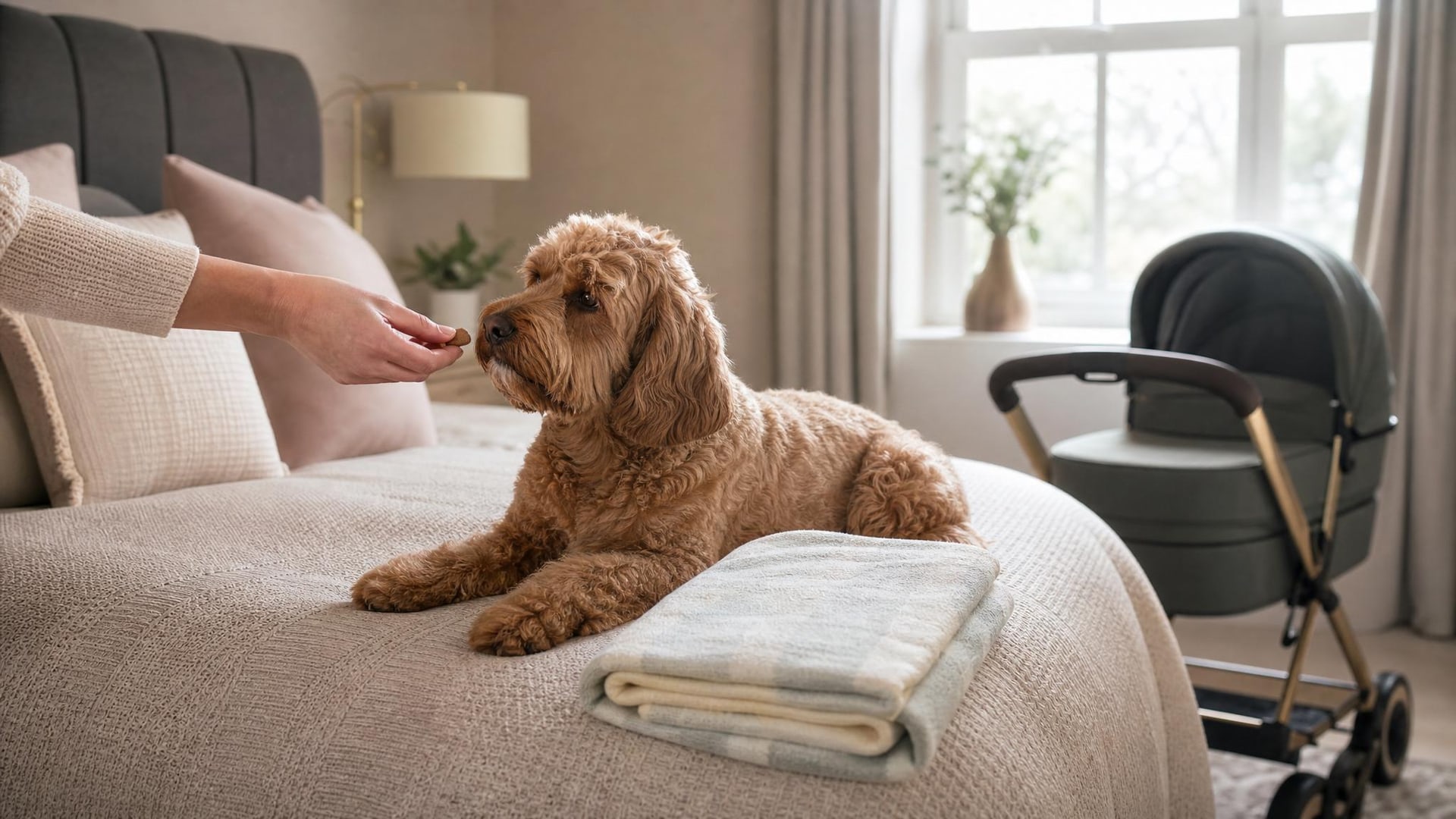
A newborn brings sensory changes your dog has never had to interpret before. Crying, squeaking, baby monitors, sterilising equipment, prams, lotions, visitors and new laundry smells can all make the home feel different.
Some dogs ignore these changes. Others bark, pace, whine, hide, stare or become restless. Gentle preparation helps your dog learn that these new sounds and smells are ordinary parts of family life.
Play baby sounds quietly while your dog is relaxed. Keep the volume low at first. If your dog stays calm, reward them with food, praise or a quiet activity they enjoy. Over time, you can increase the volume slightly, but only while your dog remains settled.
This should not feel like a stress test. The aim is not to see how much noise your dog can tolerate. The aim is to pair baby sounds with calm, low pressure experiences.
If your dog barks, paces, licks their lips, leaves the room, refuses food or stares at the speaker, make it easier. Lower the volume, move the sound further away, shorten the session, or stop and try again another day.
Before the baby comes home, let your dog calmly sniff the pram, car seat, changing mat, baby blankets and furniture. Keep it matter of fact. Allow a short investigation, reward relaxed behaviour, then guide your dog away.
Do not allow chewing, carrying or guarding. Baby items and dog items need to be clearly different from the beginning, especially if your dog already likes stealing socks, soft toys or household objects.
Some families bring home a blanket or item of clothing with the baby’s scent before the baby arrives home. This can be useful, but it should not be treated as a magic step. Scent alone does not make a dog safe around a baby.
Place the item somewhere your dog can sniff it naturally. Do not push it towards their face, crowd them, or make it an intense event. A quick sniff followed by walking away is a good result. Calm indifference is often safer than high excitement.
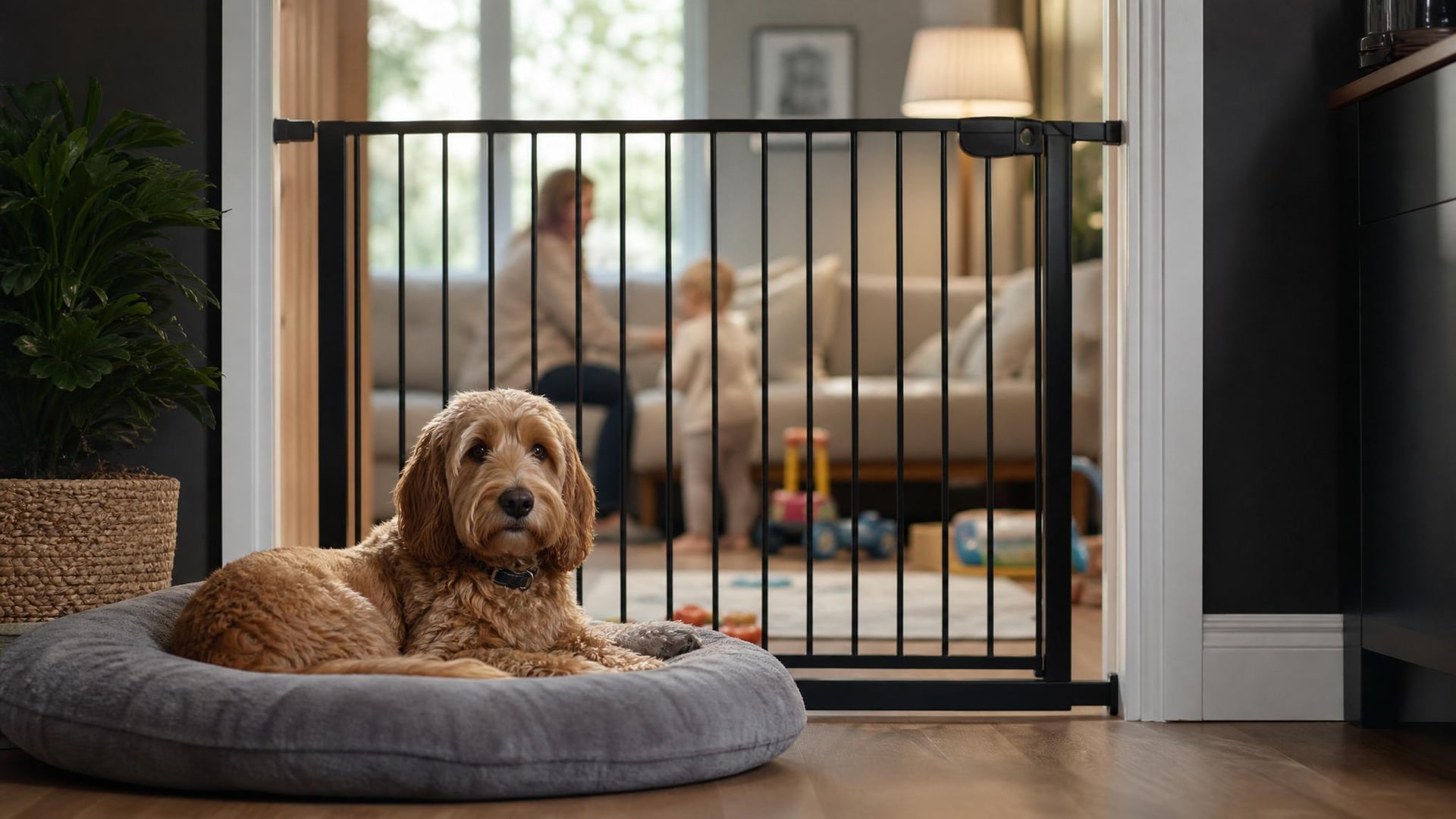
Safe introductions are not only about the first meeting. They are about how the home is managed every day afterwards. Your dog needs somewhere to rest without pressure, and your newborn needs protected space where the dog cannot reach them.
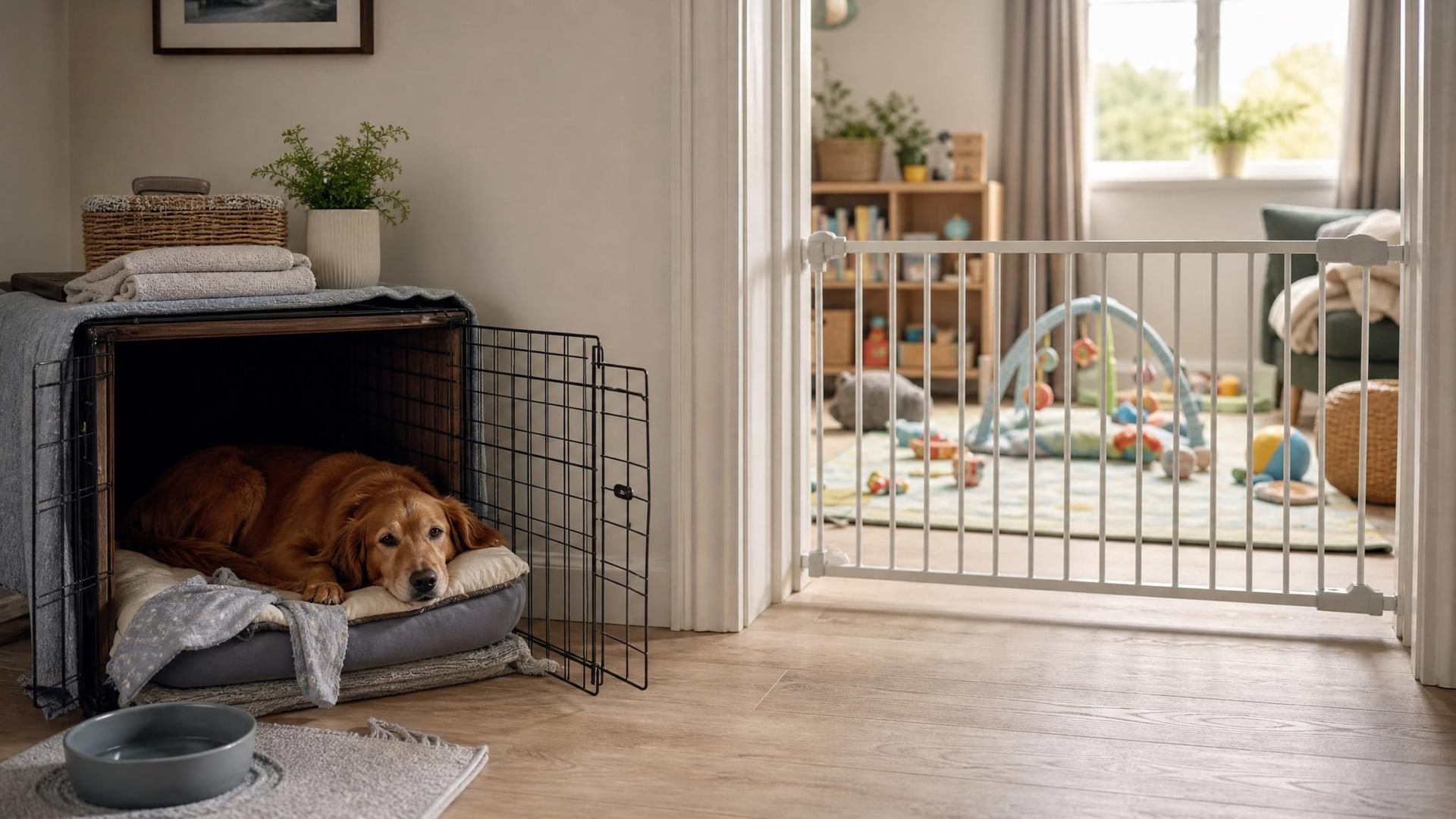
Your dog’s safe space might be a bed in a quiet room, a crate if they already enjoy using one, or an area behind a baby gate. It should feel like a retreat, not a punishment. Add comfortable bedding, water and, where appropriate, a calm activity.
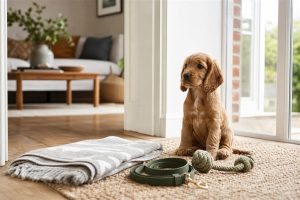
If your dog enjoys licking or slow feeding, a Dog Lick Mat that gives them a calm job to focus on can be useful during feeding times, visitor arrivals or unsettled periods. Use it as part of a calm routine, not as a way to ignore distress.
Baby gates are one of the most useful management tools because they allow your dog to remain part of family life without being right next to the baby. Your dog can see and hear what is happening, but you still have a physical barrier when you need one.
Introduce gates before the baby arrives. Toss treats behind the gate, give your dog a comfortable place to settle, and practice short periods of separation while you are still nearby.
Do not place your newborn on the floor next to your dog, even for a quick photograph. Dogs can move suddenly, and newborns are too fragile for that risk. Dogs Trust also advises against putting a child in a vulnerable position beside a dog, which is exactly the level of caution this stage needs. Keep the baby’s sleeping area, changing area and floor time protected from direct dog access.
This does not mean your dog is bad or untrusted. It means you are managing two vulnerable beings who cannot fully understand each other yet.
Your dog should not be able to access cots, Moses baskets, prams, changing mats or baby sleep spaces. These areas should stay clearly separate from Dog Toys, beds and resting spots.
If your baby is premature, unwell or immunocompromised, be extra cautious about close contact and follow advice from your GP, midwife or health visitor.
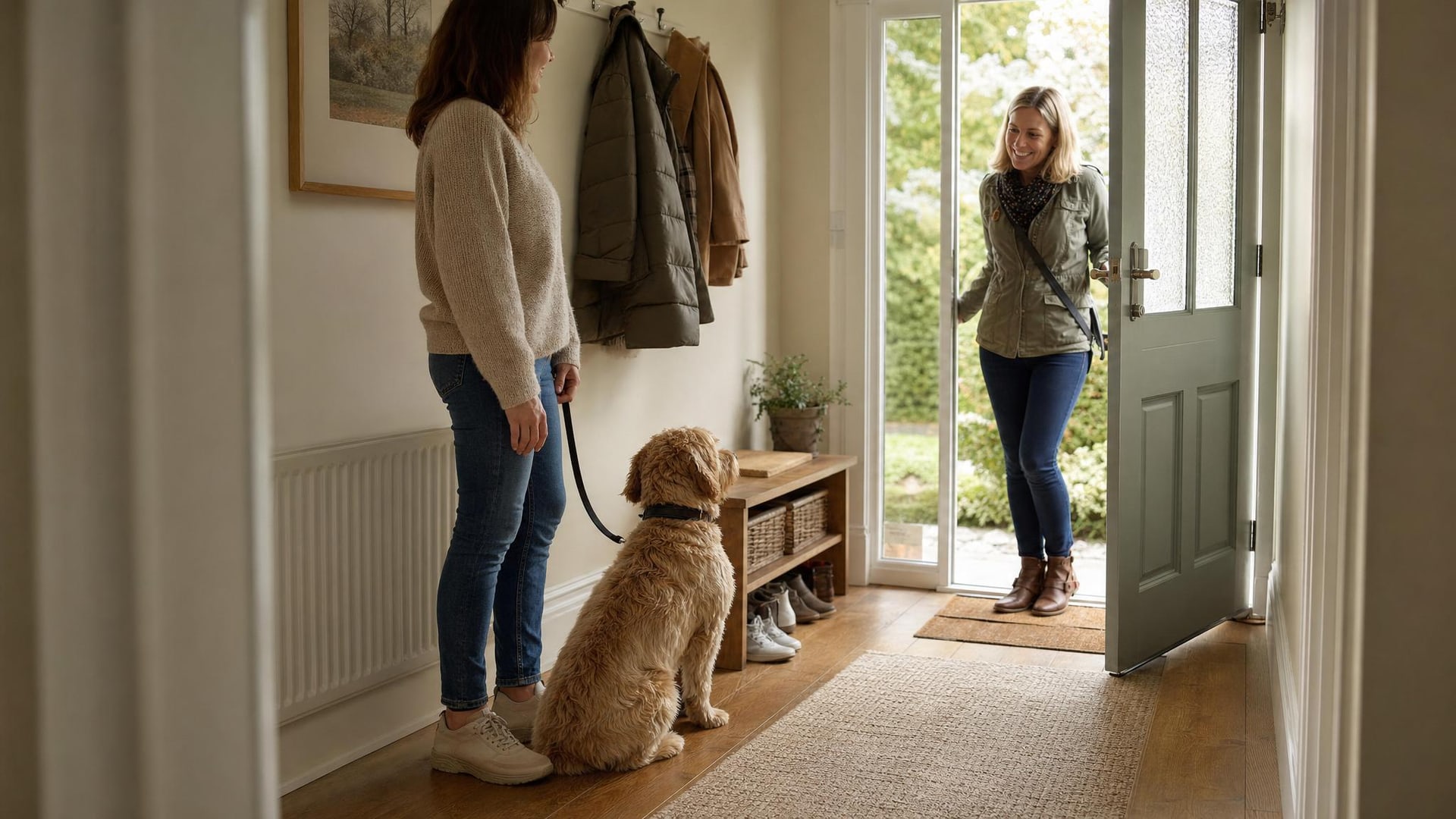
The first day home can be emotionally loaded. You may be tired, visitors may be excited, and your dog may be thrilled to see you and your visitors. A simple plan prevents the moment becoming too busy.
Visitors should not crowd your dog, encourage jumping, or insist that the dog needs to meet the baby immediately. Ask people to keep greetings calm. If your dog becomes overexcited at the door, use a Dog Lead, baby gate or separate room for the first few minutes.
Your dog does not need to perform for visitors. They need space, calm handling and a predictable routine.
If possible, let another adult hold the baby while you greet your dog first. Keep it warm but calm. If you have been away for a day or two, your dog may be more interested in you than the baby, and that is normal.
Some dogs benefit from a short walk before the first meeting. The aim is not to tire them out completely, but to take the edge off excitement. Our essential dog walking guide may help if you are planning how to keep walks steady once the baby arrives.
If you need extra control, a secure Dog Harness for controlled movement and a lead that helps you manage distance can make greetings safer. They are practical management tools, not a substitute for training or safe separation.
If you are the only adult home, do not try to hold the baby and manage an excited dog at the same time. Use a baby gate, door or crate if your dog already likes it. Greet your dog once the baby is safely out of reach, then delay the introduction until the setup is calm enough to control properly.
A Simple First Day Plan:
There is no rule that your dog must meet the baby the second you walk through the door.
Delay the introduction if your dog is barking, jumping, whining, pacing, unable to take treats, staring intensely, or struggling to settle. Also wait if the baby is crying heavily, visitors are crowding the room, or you do not have two adults available.
A delayed introduction is not a failure, it is good judgement.
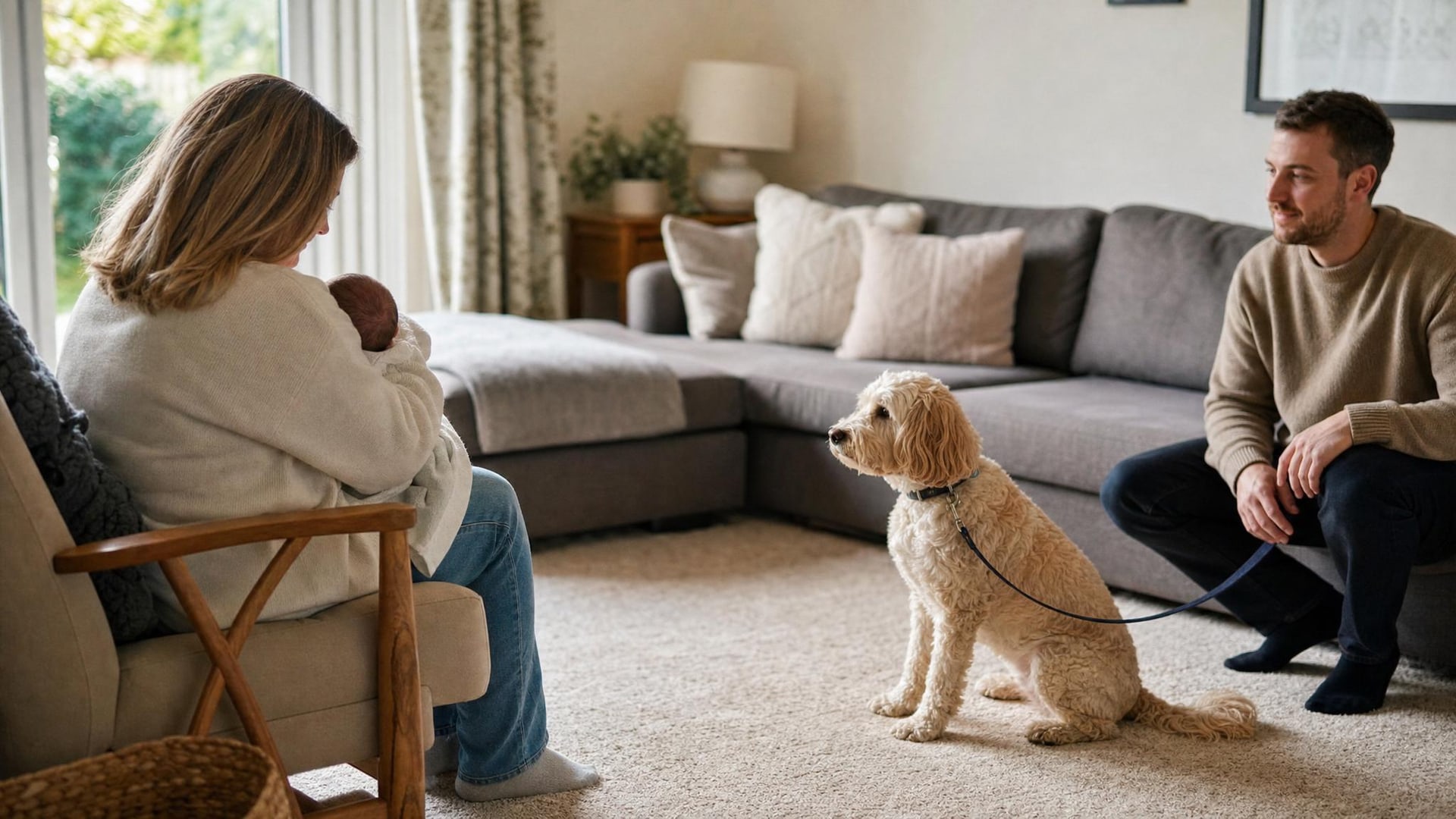
The first introduction should be short, calm and controlled. Think of it as the first of many small exposures, not a single make or break moment.
If you have more than one dog, introduce them separately at first. Two dogs together can become more excited, competitive or difficult to read. Give each dog their own calm introduction before expecting them to cope together around the baby.
Let your dog see the baby from across the room, rewarding calm behaviour. If your dog stays loose, takes treats and can look away from the baby, you can gradually reduce the distance. If they bark, pull, stiffen, whine, stare or become frantic, increase the distance again.
Distance gives your dog time to process the baby without feeling trapped or overexcited.
If your dog jumps or rushes forward, use a lead, keeping it loose where possible. A tight lead can add tension and make your dog feel restricted. The lead is there as a safety backup, while your commands and rewards guide the interaction.
One adult should focus on the baby. One adult should focus on the dog. Do not ask the person holding the baby to manage the dog at the same time.
If your dog approaches calmly, a brief sniff near the baby’s feet may be enough. Keep the baby’s face and hands away from your dog’s mouth. Do not allow licking, and do not push the baby towards the dog.
Then end the interaction before it becomes too intense. If your dog chooses to walk away, let them. The ability to disengage is one of the best signs that your dog is coping.
| Do | Do not | Why it matters |
|---|---|---|
| Have one adult for the baby and one for the dog | Ask one person to manage both | Clear roles make it easier to respond quickly |
| Start from across the room | Bring the baby straight to the dog’s face | Distance lowers pressure and excitement |
| Reward calm looking, sniffing and disengaging | Reward frantic behaviour with access | Your dog learns that calm behaviour keeps the baby nearby |
| Allow a brief foot sniff only if relaxed | Allow face licking or close mouth contact | Newborns are delicate and need protected space |
| End the meeting early | Keep going until your dog becomes tired or stressed | Short successful meetings build confidence |
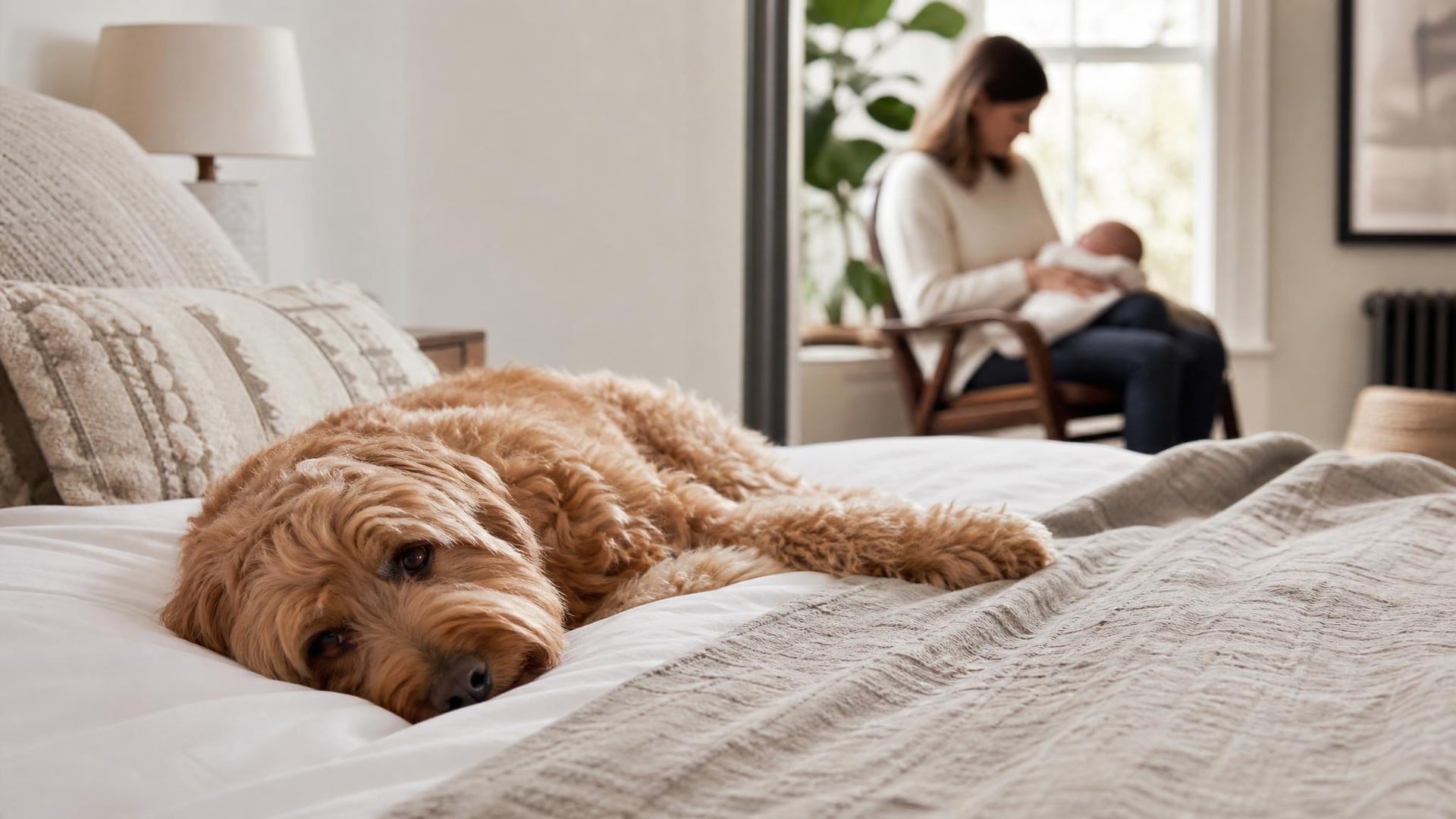
Reading your dog’s body language is one of the most important parts of newborn safety.
Dogs often show discomfort before they bark, growl or snap. The earlier you notice stress, the easier it is to create space.
A relaxed dog usually looks soft through the body. They may glance at the baby, sniff briefly, then look away or settle. They may take treats normally and respond to familiar cues.
The goal is not intense affection. Calm acceptance is safer than obsession.
Stress does not always look dramatic. Watch for lip licking, yawning when not tired, turning away, showing the whites of the eyes, freezing, pacing, trembling, hiding, refusing food, whining, barking, growling or staring intensely at the baby.
Some dogs become busy rather than still. They may grab objects, jump up, sniff frantically or struggle to settle. That can also mean the situation is too much.
| What you see | What it may mean | What to do |
|---|---|---|
| Loose body, brief look, then looks away | Your dog is noticing the baby without fixating | Reward calmly and keep the interaction short |
| Lip licking, yawning, turning away or avoiding | Your dog may be uncomfortable or unsure | Create more distance and lower the pressure |
| Stiff body, hard stare or freezing | Your dog may be highly stressed or conflicted | End the interaction and use separation |
| Barking, whining, pacing or frantic sniffing | The baby sound or movement may be too much | Increase distance and give your dog a calm task |
| Growling, snapping or guarding space | Your dog is warning that they need space | Move the baby away and contact a professional if repeated |
Create distance calmly. Move the baby away, guide your dog to their safe space, or end the interaction. Do not wait for your dog to become louder. Do not tell them off for showing discomfort.
If your dog often seems unsettled by noise or change, our guide to recognising signs of anxiety in dogs may help you understand what you are seeing.
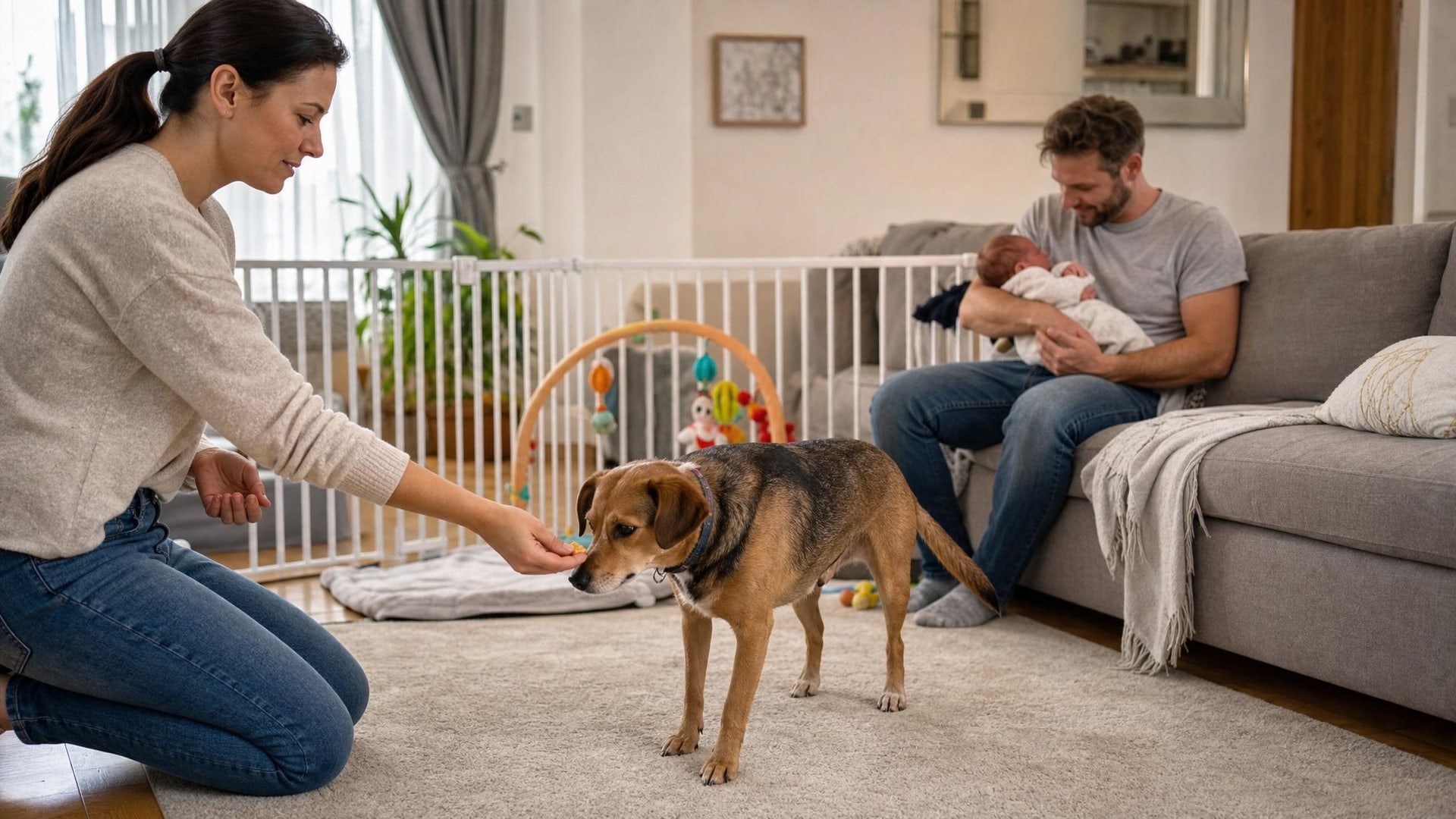
Specific behaviours can feel frightening around a newborn. The right response is calm management, not panic. Your job is to keep the baby safe, reduce pressure on the dog and avoid accidentally making the behaviour worse.
A growl is communication. Your dog is saying they are uncomfortable and need space. If you punish growls, you may stop the warning sound without changing how your dog feels. That can make things more dangerous because the dog may stop warning you before reacting.
If your dog growls near the baby, move the baby away first. Give your dog space. Do not shout, grab, scold or force them to remain near the baby.
Afterwards, look at the context. Was your dog trapped? Was the baby too close? Were visitors crowding the room? Was your dog guarding food, a bed, a toy or a person?
If growling happens again, speak to your vet or a qualified animal behaviourist. Around a newborn, repeated growling is not something to manage by guesswork.
Jumping is often excitement, but around a newborn it needs careful management.
Practice calm approaches with all four paws on the floor. Use a lead or barrier when needed, and reward your dog before they jump rather than after they have already become too excited.
If your dog jumps during the introduction, increase the distance immediately and reset. Do not push the baby closer to ‘get it over with’. A failed attempt can simply become useful information; your dog needs more distance, more preparation or a calmer time of day.
A baby’s cry can be startling. Your dog may bark because they are worried, excited, frustrated or unsure what to do. Try not to react sharply. If you become tense, your dog may think the crying is genuinely alarming.
Give your dog a predictable routine. When the baby cries, you might guide your dog to their bed, scatter a few treats, offer a chew, or provide a lick mat in their safe space. If your dog is very distressed, increase the distance and build exposure slowly.
It is also worth watching patterns. Some dogs only react to sudden crying from sleep. Some react when the baby is being carried. Some react when visitors fuss around the baby. Knowing the trigger helps you manage the moment more intelligently.
Some dogs lick because they are curious. Others lick because they are excited, anxious or seeking attention. It is best not to allow licking around a newborn’s face or hands. Babies have delicate skin and developing immune systems, so close licking is not worth the risk.
Redirect before licking happens. Ask for a sit, guide your dog slightly away, or reward them for settling nearby. Keep it calm and consistent. Do not turn licking into a dramatic event that gives your dog more attention for trying again.
Real life example – If the baby starts crying during a feed and your dog rushes over barking, do not try to soothe both at once in the same space.
Create distance first. Ask your dog to go behind a gate or onto their bed, scatter a few treats, then deal with the baby. Once the pattern is calmer, your dog can learn that crying predicts a simple routine rather than a frantic household reaction.
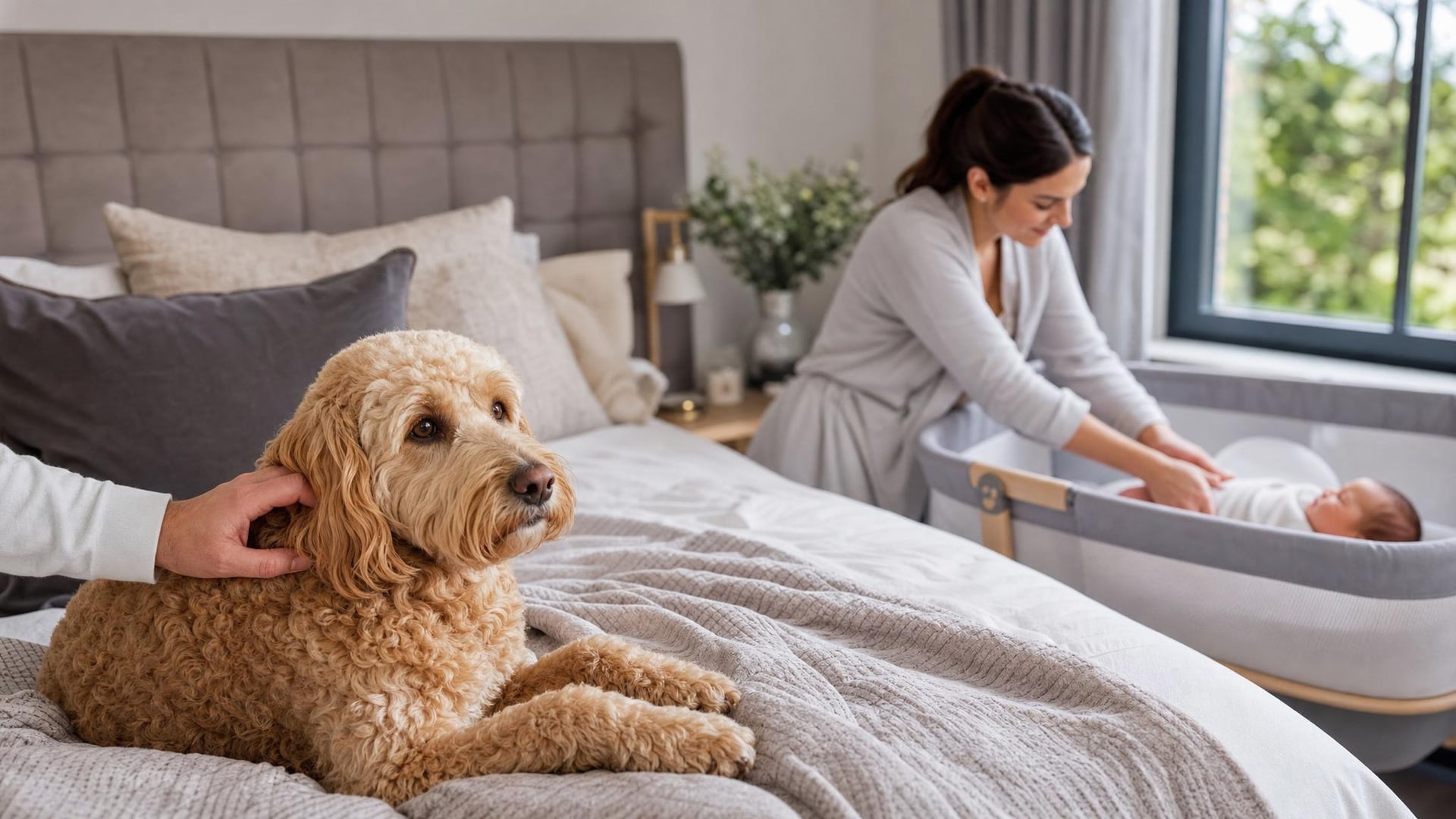
Dogs do not understand jealousy exactly as people do, but they do notice attention changes. A dog who was once central to your routine may suddenly find that your hands, voice and attention are often focused elsewhere.
Your dog may bark more, bring toys, steal baby items, push between you and the baby, follow you constantly or behave in ways that usually get a reaction. This does not mean your dog is spiteful. It usually means they are trying to understand how to get attention in a changed household.
Try to notice the behaviours that appear when you are holding, feeding or soothing the baby. Those moments tell you where your dog needs more structure. If they bring toys, nudge your arm or bark for attention, plan a calm alternative before the behaviour becomes a habit.
Try not to make the baby’s presence the moment your dog is always pushed away.
Instead, include your dog in calm, safe ways. Drop treats onto their bed while you feed the baby. Praise them for settling while the baby is nearby. Give them calm attention when the baby is present, not only when the baby is asleep.
Your dog does not need direct access to the baby to feel included. They need predictable reassurance that they still belong in family life.
Feeding and nappy changes are good moments for planned calm activities. A chew, lick mat, stuffed food toy, snuffle game or suitable toy can help your dog settle while your attention is on the baby. Choosing toys that suit calm chewing, sniffing or problem solving that suit calm chewing, sniffing or problem solving can make those busy moments easier to manage.
Keep activities safe and supervised. If your dog guards food or toys, use separation and speak to a professional for advice.
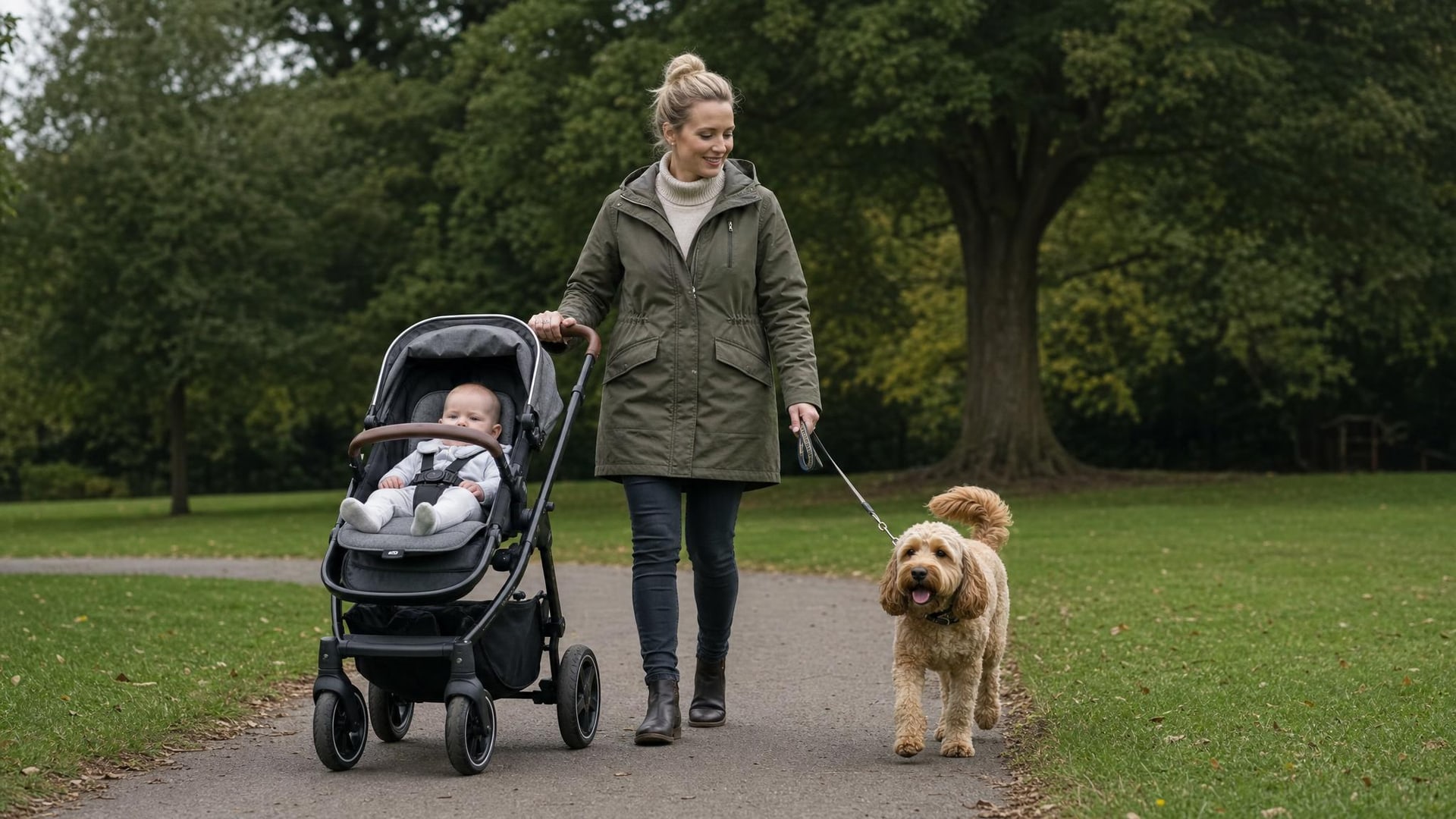
The first weeks with a newborn are unpredictable, but dogs still benefit from small pieces of consistency. You may not be able to keep every routine exactly the same, and that is fine. Aim for enough predictability that your dog can relax.
Plan who will walk your dog during the first few days home. This might be a partner, family member, friend or trusted dog walker. If pram walks are part of your future routine, practise walking near the pram before the baby arrives, without letting your dog pull across wheels or tangle the lead.
A secure harness and reliable lead can make this easier, especially while you are managing new routines and distractions.
Keep feeding times as steady as you can. Give your dog quiet rest away from visitors and baby noise. A tired, overstimulated dog is more likely to make poor choices, so rest is as important as exercise.
Visitors can disrupt rest as much as the baby does. Give your dog protected downtime away from the busiest room, especially if they are the kind of dog who tries to stay involved even when they are tired.
Sniffing games, food puzzles, chewing and licking can help your dog settle when you are feeding, changing or soothing the baby. These activities should not replace walks or attention, but they can make busy moments more manageable.
Prepare these activities before you need them. If the baby is already crying and your dog is already excited, it is harder to set up a calm routine. Having safe chews, food puzzles or scatter feeding ready makes the moment easier.
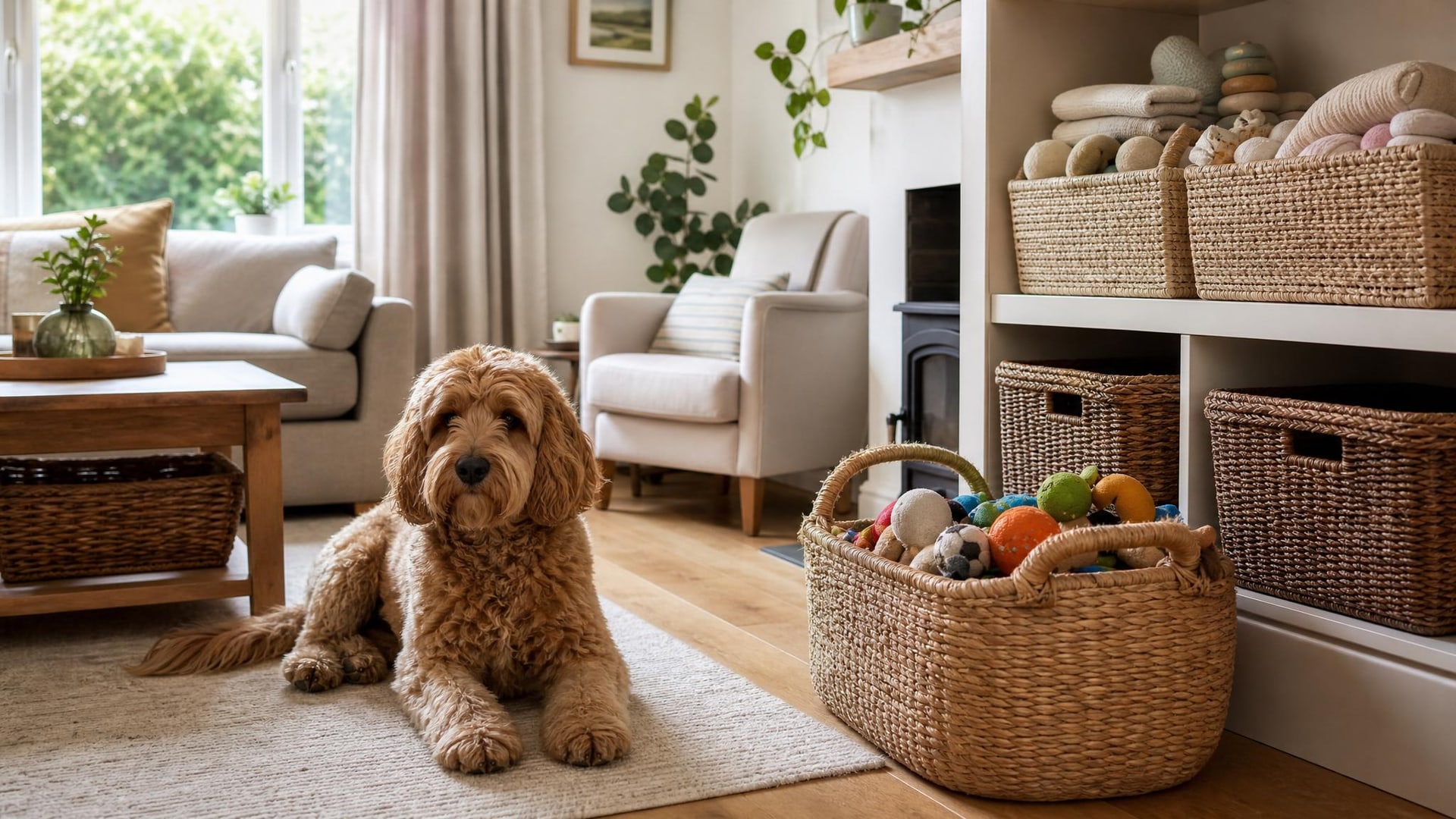
Baby toys and dog toys can look similar to a dog. Soft fabric, squeakers, blankets and small items can all become confusing. The clearer you make the difference, the easier it is for your dog to succeed.
Many baby items smell interesting, move unpredictably or feel similar to objects your dog is allowed to chew. Keep baby toys, muslins, dummies and clothes out of reach where possible. Store dog toys in a separate basket so the choice is obvious.
This is especially important with soft toys. To a dog, a baby comforter and a plush dog toy may look almost identical. Clear storage and consistent swaps help your dog learn which items belong to them.
Do not chase your dog around the room. Chasing can turn stealing into a game or make your dog more likely to guard the item. Instead, calmly swap the baby item for a treat or one of your dog’s own toys. Practise ‘drop’ and ‘leave’ before you need them in a real situation.
After the swap, put the baby item out of reach and give your dog something appropriate to do. Repeated stealing usually means the environment needs better management, not that your dog is deliberately being difficult.
If your dog stiffens, growls, snaps or runs away when you approach an item, that may be resource guarding. Do not try to force items from their mouth. Speak to your vet or a qualified behaviourist, especially before the baby becomes mobile.
Early help matters because guarding can become more serious once a baby starts crawling and reaching for objects. A behaviourist can help you build safer swaps, storage routines and management before the risk increases.
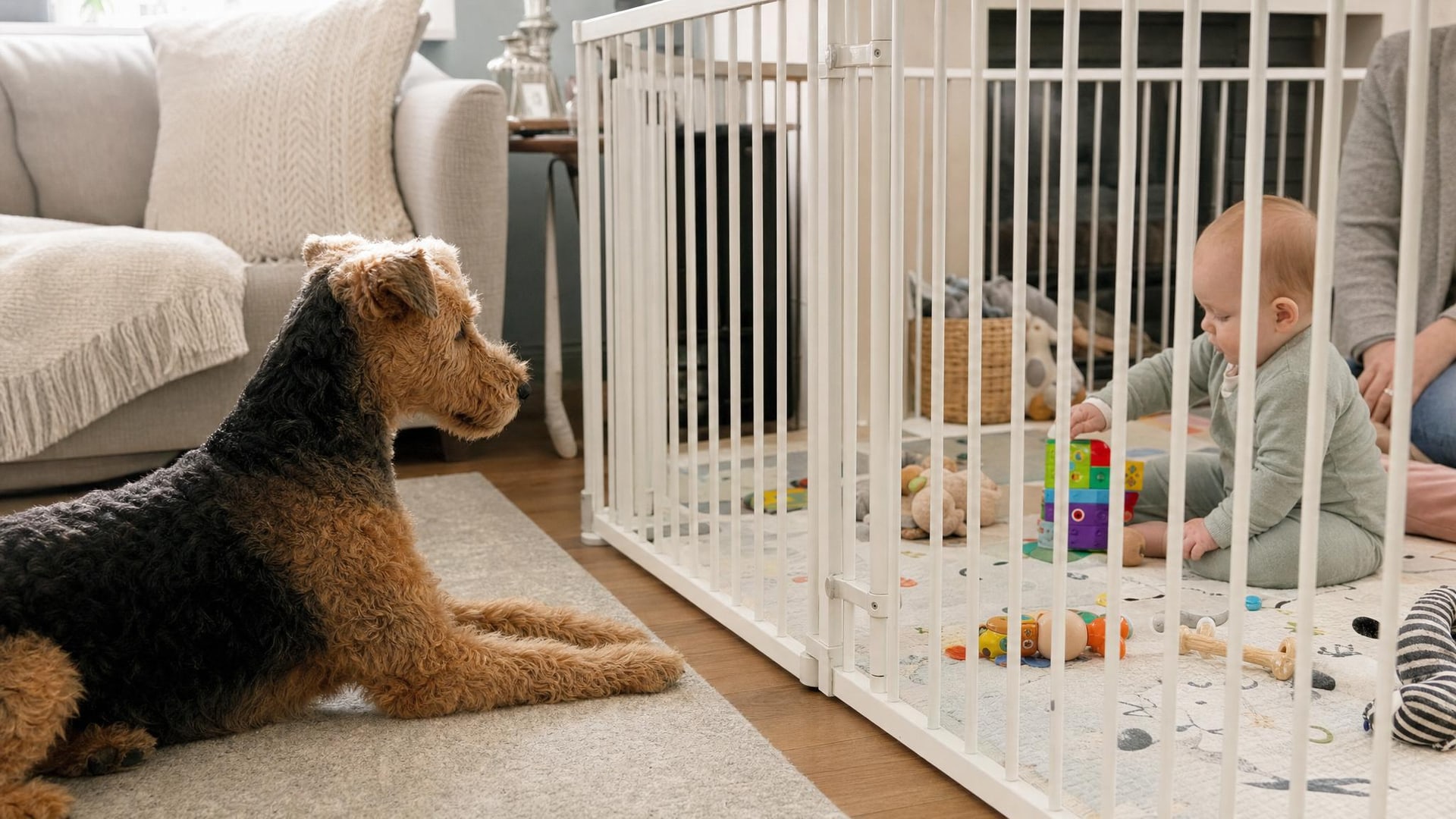
This is the most important rule in the whole article. Never leave your dog alone with your newborn, even for a moment. It does not matter how gentle your dog is, how long you have had them, or whether they have been good around children before.
Supervision means you are awake, present and able to intervene immediately. It does not mean you are in the same room while looking at your phone, asleep on the sofa, cooking with your back turned, or stepping out ‘just for a second’.
Newborns can make sudden sounds. Dogs can move suddenly. Accidents can happen quickly. Good supervision is active, not passive.
If you need to leave the room, take the baby with you or separate your dog safely using a door, crate if already positive, or baby gate. This rule should continue as your baby grows. Crawling, grabbing, squealing and unsteady movement can all be difficult for dogs to understand.
Dogs Trust, PDSA and Battersea all place strong emphasis on supervision and safe separation around babies and children. It is not overcautious. It is responsible dog ownership.
A newborn is usually still, carried or placed safely out of reach. A crawling baby is different. Once your baby starts moving, your dog may face a whole new set of challenges.
Crawling babies can move towards dogs, reach for fur, grab tails, touch toys, crawl into beds and make sudden noises at floor level. Even a dog who coped well with the newborn stage may find this harder.
From your dog’s point of view, a crawling baby may seem much less predictable than a newborn. They are lower to the ground, closer to the dog’s toys and bed, and more likely to move directly towards the dog without understanding personal space.
Your dog’s bed, crate or quiet area should be protected from the baby. Babies should not be allowed to climb on dogs, follow them into beds, pull ears or tails, or take dog toys. These rules protect your dog as well as your child.
A resting dog should be left alone. This is a rule for adults to enforce, not something a baby can understand. If your dog learns that their bed is genuinely safe, they are more likely to choose it when they need a break.
Do not wait until your baby is already crawling towards the dog’s bed. Review baby gates, play spaces, dog toy storage and rest areas in advance. The newborn stage can feel all consuming, but the mobile stage often needs even more active management.
Think ahead rather than waiting for the first problem. Where will the baby play? Where will the dog rest? Where will dog toys be stored? Which doors or gates need to be closed before floor time begins?
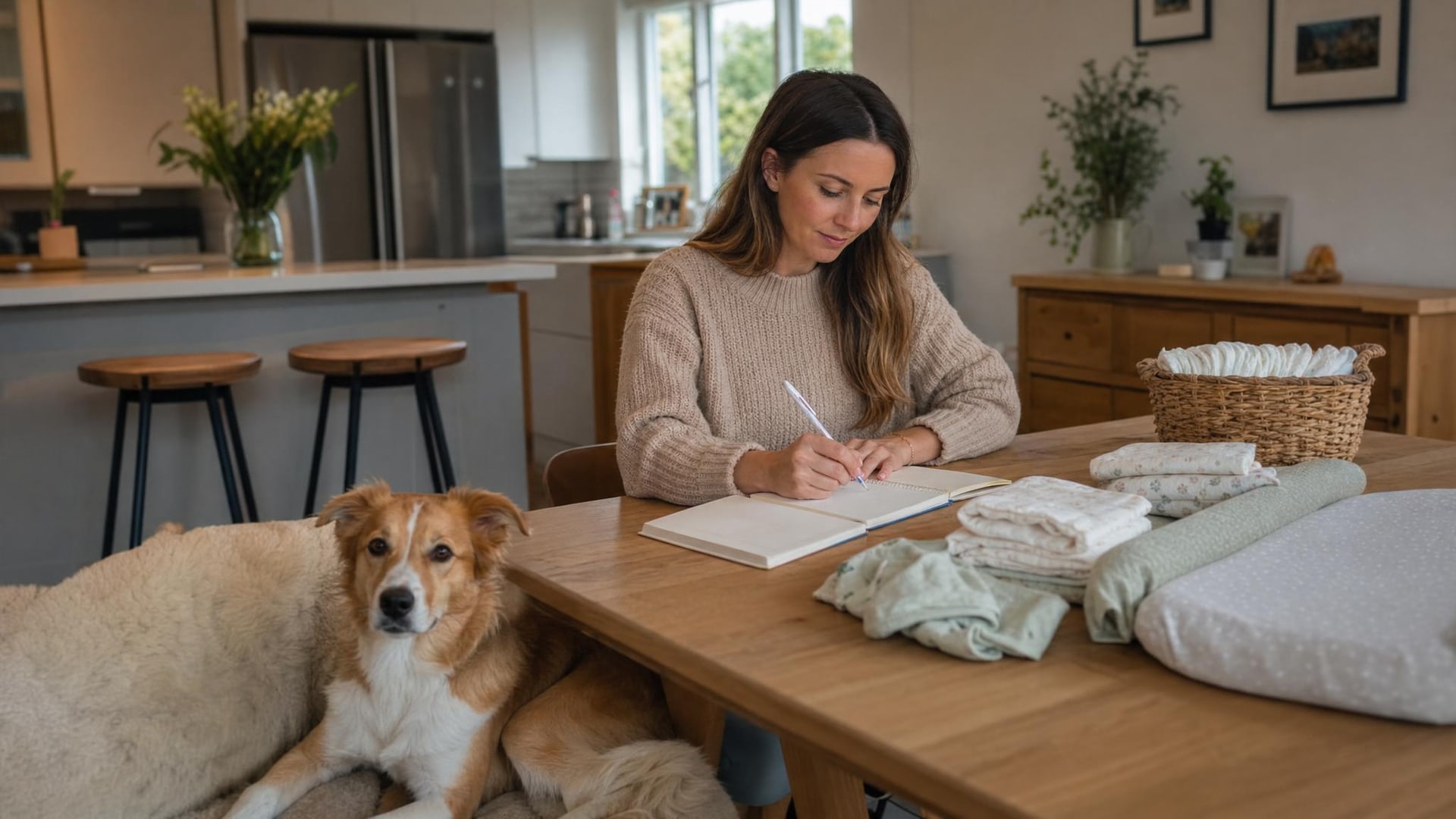
The biggest mistake is expecting too much too soon. Your dog does not understand the situation in the same way you do, and your baby cannot behave predictably around them.
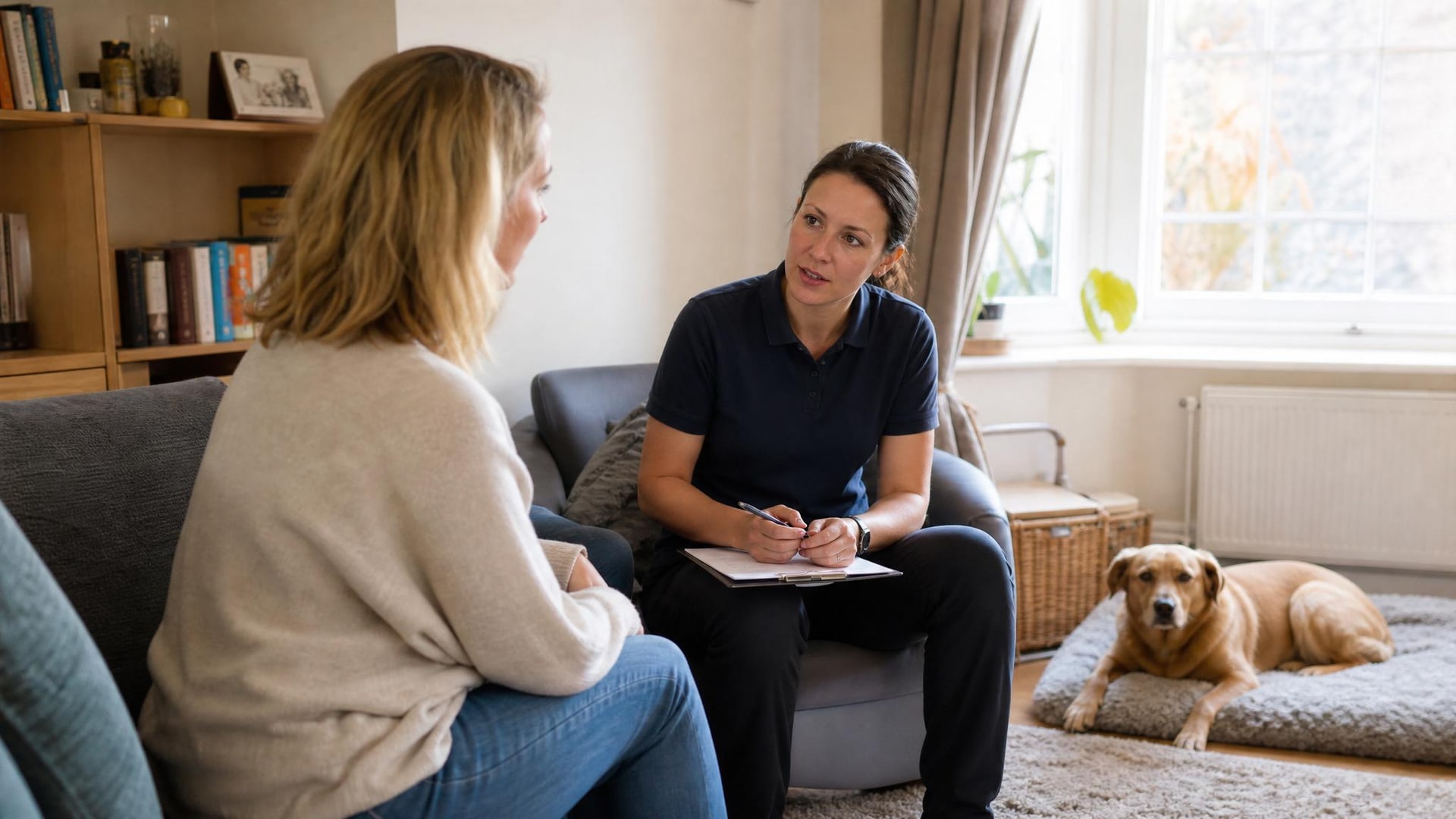
Some situations need expert support. It is always better to ask early than wait until behaviour becomes more serious.
Speak to your vet or a qualified dog behaviourist if your dog has a history of aggression, guards food or toys, growls near the baby, snaps, lunges, bares teeth, becomes intensely fixed on the baby, cannot settle when the baby cries, or shows severe anxiety around baby items and sounds.
Do not minimise behaviour because your dog is usually loving. A dog can be affectionate and still unsafe in a specific situation. Repeated fixation, guarding or stress around the baby deserves proper support.
Red flags to act on quickly – Growling more than once, snapping, lunging, hard staring, blocking access to the baby, guarding baby items, distress when the baby cries, following the baby intensely, or being unable to disengage. If you see these behaviours, use separation and get qualified help rather than trying to solve it through trial and error.
Your vet is a sensible first contact because pain, illness and stress can all affect behaviour.
For behaviour support, the Animal Behaviour and Training Council practitioner directory can help UK owners find registered behaviour and training professionals. If your dog has a bite history, guarding behaviour, intense fixation, severe anxiety or very little exposure to children, arrange advice before the baby arrives if possible.
Avoid trainers who promise quick fixes through intimidation or punishment. Around babies, the goal is safer emotional responses and better management, not simply suppressing warning signs.
You do not need to wait for a dramatic incident. If something feels wrong, ask for help. Newborn life is tiring enough without trying to guess your way through worrying dog behaviour.
Parents often wait because they worry they are overreacting. With a newborn in the house, early advice is sensible. A good professional can help you decide what is normal adjustment and what needs a clearer safety plan.
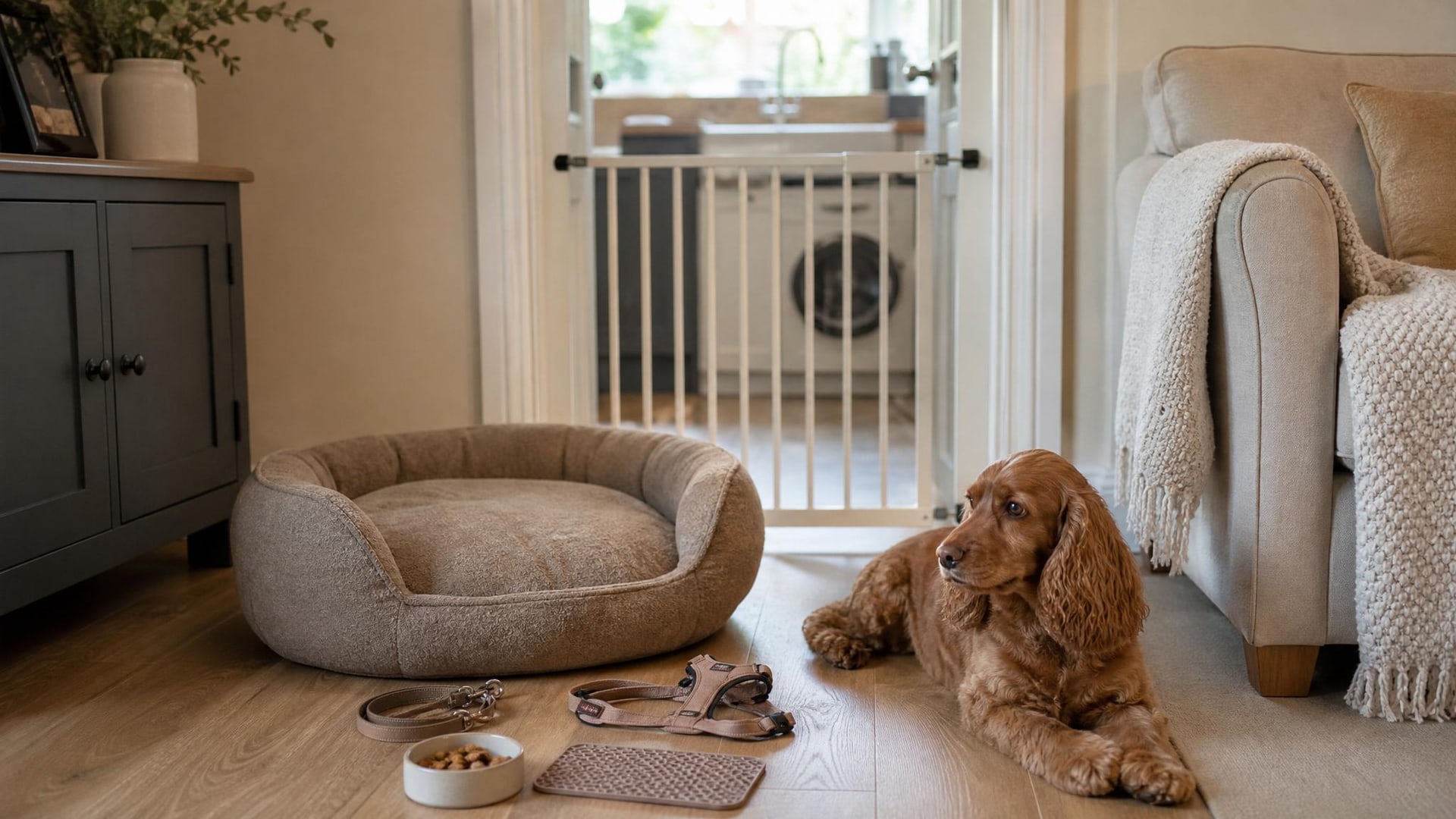
You do not need a house full of new dog products before the baby arrives, but a few practical items can make the transition smoother. The point is function; safe separation, calm settling, controlled movement and predictable routines.
| Item | Why it helps | When to use it |
|---|---|---|
| Baby gate | Creates safe separation while keeping your dog near family life | During feeding, visitors, floor time and short room changes |
| Comfortable dog bed | Gives your dog a clear resting place | Before birth and throughout the first months |
| A harness that gives steady control | Helps manage excited movement without pressure on the neck | First meetings, visitor arrivals and pram walk practice |
| A lead for safe distance | Gives gentle control when distance matters | Door greetings, introductions and walks |
| Lick mat or slow feeder | Encourages calm, focused activity | Feeding times, nappy changes or settled periods |
| Toys for calm chewing or sniffing | Helps your dog distinguish their own items from baby items | Quiet enrichment and swaps when your dog picks up the wrong thing |
| Small treats | Rewards calm behaviour quickly | Sound practice, first meetings and settling exercises |
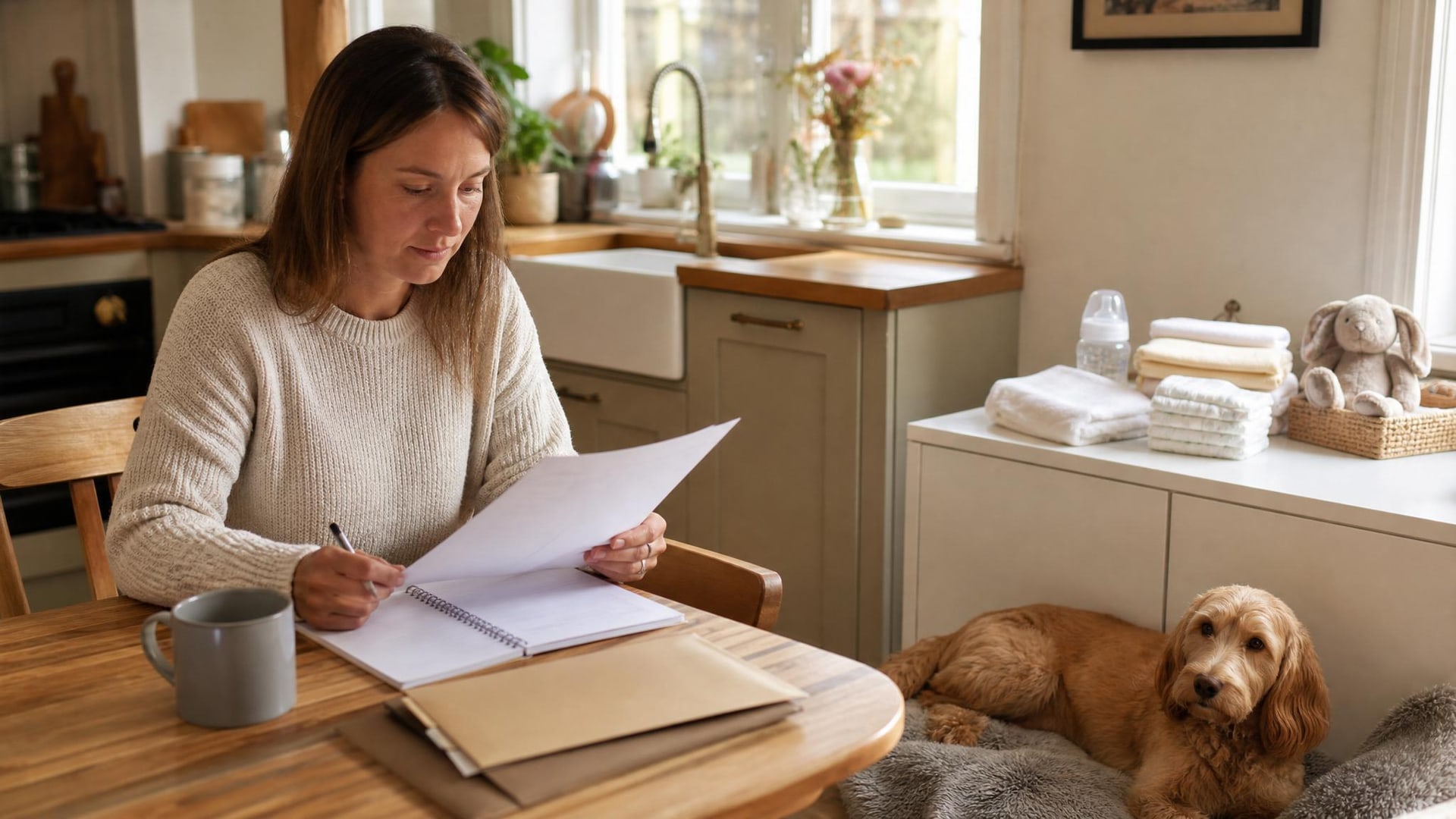
Use this checklist as a practical final review before your baby comes home and during the first few weeks.
Introducing your dog to a newborn baby is not about forcing a perfect first meeting. It is about building a calm, predictable home where your dog understands what is expected and your baby is protected at every stage.
The safest approach starts before the baby comes home. If your dog already knows how to settle, move away when asked, walk calmly beside the pram and rest behind a gate without feeling shut out, the first few weeks become much easier to manage.
Once your baby is home, keep the introduction quiet and controlled. Let your dog notice the baby from a safe distance, reward calm behaviour and end the moment before your dog becomes worried, frustrated or too excited. A short, calm introduction is far better than a long one that pushes your dog past their limit.
Watch your dog’s body language closely. Turning away, lip licking, yawning, stiff posture, whale eye, growling or repeated attempts to escape are not signs to punish. They are information. If you listen early, you can create more distance, reduce pressure and prevent small worries becoming serious problems.
The rule that matters most is simple; never leave your dog and baby alone together, even for a moment.
Good dogs can still be startled. Babies move unpredictably. Safe management protects both of them.
With preparation, supervision and realistic expectations, most dogs can adjust well to life with a newborn. Keep routines as steady as you can, give your dog calm jobs to do, protect their rest space and ask for professional help early if you see behaviour that worries you.
That is how you help your dog feel secure while giving your baby the safest possible start around them.
Some dogs adjust within days. Others need several weeks or longer. It depends on temperament, routine, confidence, previous experience with children and how calmly the introduction is managed. Do not rush closeness. Calm acceptance is a better early goal than affection.
A brief sniff near the baby’s feet can be fine if your dog is relaxed and one adult is managing them closely. Avoid the baby’s face and hands. If your dog is excited, stiff, barking, staring or unsure, create more distance and try again later.
Dogs can be around newborn babies with close adult supervision, safe separation and sensible boundaries. They should never be left alone together. Supervision means you are awake, present and able to intervene immediately.
Move the baby away calmly and give your dog space. Do not punish the growl. A growl means your dog is uncomfortable. Stop the interaction and speak to your vet or a qualified behaviourist if it happens again.
Your dog may bark because the crying is unfamiliar, stressful, exciting or confusing. Stay calm, increase distance if needed, and give your dog something predictable to do, such as going to their bed, taking treats or using a lick mat in their quiet space.
No. It is best not to allow licking around a newborn’s face or hands. Redirect calmly and reward your dog for sitting, lying down or settling nearby instead.
Only if there is safe separation and your dog cannot reach the baby’s cot, crib or sleeping area. For many families, it is simpler to give the dog their own sleeping space outside the baby’s room.
Include your dog in calm, safe ways rather than constantly pushing them away. Reward settling while the baby is present, offer quiet activities during feeding or nappy changes, and keep routines as steady as possible. If behaviour becomes intense or worrying, seek professional help.